Have you ever received a message that says “ima call you later” or “ima head out now” and wondered what “IMA” means?
You’re not alone. Internet slang changes fast, and new abbreviations appear across texting apps, social media platforms, and online chats every day.
Many people search for the meaning of IMA because they see it on Snapchat, TikTok, Instagram, WhatsApp, or in casual text conversations.
The good news is that IMA is actually very simple. It’s commonly used to make messages shorter, quicker, and more conversational.
Understanding it can help you keep up with online communication and avoid confusion when chatting with friends.
In this guide, you’ll learn exactly what IMA means in text, where it came from, how people use it, examples of real conversations, possible alternate meanings, and whether it’s still popular in 2026.
What Does IMA Mean in Texting?
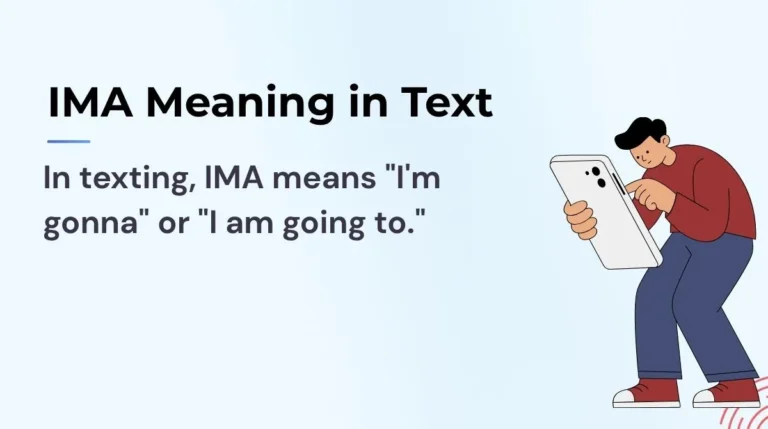
In texting, IMA means “I’m gonna” or “I am going to.”
It is an informal slang expression used to indicate that someone is about to do something.
Examples
- IMA grab some food.
- IMA call you tonight.
- IMA watch that movie later.
- IMA head home now.
In each example, “IMA” simply replaces:
- I’m going to
- I am going to
- I’m gonna
The meaning remains exactly the same.
Featured Snippet Answer
IMA in text means “I’m gonna” or “I am going to.” It is internet slang used in casual conversations to indicate a future action or intention.
Full Form & Short Meaning of IMA
Unlike many internet abbreviations, IMA is not always considered a true acronym.
Short Meaning
IMA = I’m gonna / I am going to
Expanded Version
- I = I
- M = am
- A = about to / going to (informally combined)
Over time, people began typing “ima” as a shortened phonetic version of how “I’m gonna” sounds when spoken quickly.
Example
Standard English:
I am going to leave now.
Text Version:
Ima leave now.
Both sentences mean the same thing.
Origin & History of IMA
IMA comes from informal spoken English, particularly conversational American English.
When people speak quickly, phrases like:
- I’m going to
- I am going to
often sound similar to:
- I’ma
- Ima
As texting became more popular in the early days of mobile phones, users started typing words the way they sounded in speech. This trend spread through:
- SMS texting
- Online forums
- Chat rooms
- Social media
- Gaming communities
Later, platforms like TikTok, Snapchat, Instagram, and X helped popularize casual shorthand expressions such as:
- Ima
- Gonna
- Wanna
- Finna
- Bruh
Today, IMA is recognized as a common piece of internet slang.
Why Do People Use IMA Online?
People use IMA because it feels natural, fast, and conversational.
Reasons for Using IMA
1. It Saves Time
Typing:
Ima text you later
is faster than typing:
I am going to text you later.
2. It Sounds Casual
IMA creates a relaxed tone among friends.
3. It Mimics Real Speech
Many people type the way they talk.
4. It Fits Social Media Culture
Short messages perform well on social platforms and messaging apps.
5. It Feels More Personal
Using casual slang often makes conversations feel more friendly and natural.
IMA Meaning on Snapchat, TikTok, Instagram & WhatsApp
Although the meaning stays mostly the same, the way people use IMA can vary slightly by platform.
Snapchat
On Snapchat, IMA often appears in quick chats and snaps.
Examples:
- Ima send it 😂
- Ima be there in 5 mins
TikTok
TikTok users frequently use IMA in comments and captions.
Examples:
- Ima need part 2 ASAP.
- Ima cry if this gets deleted.
On Instagram, you’ll see it in DMs, stories, and comment sections.
Examples:
- Ima repost this.
- Ima steal this caption.
WhatsApp conversations often use IMA among friends and family.
Examples:
- Ima call you after dinner.
- Ima send the photos later.
Across all these platforms, the meaning remains “I’m going to.”
Different Meanings of IMA in Other Contexts
Although texting slang is the most common meaning, IMA can represent different things depending on the context.
1. Indian Medical Association
In healthcare discussions, IMA may refer to the Indian Medical Association.
2. Investment Management Agreement
In finance, IMA can stand for Investment Management Agreement.
3. Institute of Management Accountants
In accounting and business, IMA may refer to the Institute of Management Accountants.
4. Internet Slang
In everyday online conversations:
IMA = I’m gonna / I am going to
Always use context to determine which meaning applies.
Real Chat Examples of IMA
Here are some realistic examples of how people use IMA in messages.
Example 1
Friend 1:
Ima order pizza 🍕
Friend 2:
Get extra cheese.
Example 2
Friend 1:
Ima go to sleep 😴
Friend 2:
Goodnight!
Example 3
Friend 1:
Ima watch the game tonight.
Friend 2:
Same here.
Example 4
Friend 1:
Ima delete this if nobody likes it 😂
Friend 2:
Keep it up.
Example 5
Friend 1:
Ima be honest…
Friend 2:
Uh oh 😭
Example 6
Friend 1:
Ima call you later.
Friend 2:
Sounds good.
How to Reply to IMA
The best reply depends on the conversation.
Casual Replies
- Cool.
- Sounds good.
- Go for it.
- Okay.
- Have fun.
Funny Replies
- Do it, no excuses.
- I’ll believe it when I see it 😂
- Finally.
- About time.
Serious Replies
- Let me know how it goes.
- Keep me updated.
- Be careful.
- Good luck.
Flirty Replies
- Ima miss you.
- Save some time for me 😉
- Don’t forget about me.
- I’ll be waiting.
Common Confusions & Mistakes
Many people misunderstand IMA because internet slang can have multiple meanings.
Mistake 1: Thinking It’s an Official Acronym
In most chats, IMA simply means:
I’m gonna
not an organization or institution.
Mistake 2: Confusing IMA With IMAO
These are different terms.
- IMA = I’m gonna
- IMAO = In My Arrogant Opinion (or a variation of IMHO)
Mistake 3: Using It in Formal Writing
IMA is casual slang.
Avoid using it in:
- Business emails
- Academic papers
- Professional reports
Mistake 4: Misreading the Context
In business, medicine, or finance discussions, IMA may have a completely different meaning.
Similar Slang Terms & Alternatives
If you understand IMA, you’ll probably recognize these related slang expressions too.
| Slang | Meaning |
|---|---|
| Gonna | Going to |
| Wanna | Want to |
| Finna | About to |
| IDK | I don’t know |
| TBH | To be honest |
| IMO | In my opinion |
| BRB | Be right back |
| NGL | Not gonna lie |
| FR | For real |
| SMH | Shaking my head |
These terms are commonly used across social media and texting platforms.
Is IMA Still Popular in 2026?
Yes, IMA remains popular in 2026.
While Gen Z and younger internet users constantly create new slang, IMA continues to be widely understood because it is simple and practical.
Reasons it remains popular include:
- Easy to type
- Easy to understand
- Common in texting
- Works across platforms
- Sounds natural in conversation
Although newer slang terms appear every year, IMA remains part of everyday digital communication.
Quick Meaning Table
| Term | Meaning | Usage | Platform | Tone |
|---|---|---|---|---|
| IMA | I’m gonna | Future action | Snapchat | Casual |
| IMA | I am going to | Text messages | Friendly | |
| IMA | I’m gonna | Social media comments | TikTok | Informal |
| IMA | I am going to | Direct messages | Conversational | |
| IMA | Future intention | Online chats | Multiple platforms | Relaxed |
FAQs
What does IMA mean in a text message?
IMA usually means “I’m gonna” or “I am going to.” It shows that someone plans to do something.
Is IMA the same as gonna?
Yes. Both expressions communicate a future action or intention.
What does Ima call you later mean?
It means “I am going to call you later.”
Is IMA a Gen Z slang term?
Yes, it is commonly used by Gen Z and younger internet users, although people of many ages understand it.
Can I use IMA in professional emails?
No. It is best reserved for casual conversations and social media.
What platform uses IMA the most?
You’ll commonly see it on Snapchat, TikTok, Instagram, WhatsApp, and text messages.
Is IMA rude?
No. It is generally neutral and friendly. The tone depends on the rest of the message.
Does IMA always mean I’m gonna?
In casual texting, yes. However, in professional fields like healthcare or finance, IMA may have different meanings.
How do you pronounce IMA?
Most people pronounce it similarly to “I’ma” or “eye-mah,” depending on their accent and speaking style.
Conclusion
IMA is one of those internet slang terms that looks confusing at first but is actually very simple.
In most text messages, Snapchat chats, TikTok comments, Instagram DMs, and WhatsApp conversations, it means “I’m gonna” or “I am going to.” People use it because it’s fast, casual, and mirrors everyday speech.
Understanding common slang like IMA can make online conversations easier to follow and help you communicate more naturally with friends, classmates, and social media communities.
While new internet expressions continue to appear every year, IMA remains a widely recognized and useful shorthand in 2026.
So the next time someone texts, “Ima call you later,” you’ll know exactly what they mean.

Dylan Archer — the mind behind LaughterBooks, turning everyday moments into punchlines that hit perfectly.